
Preventive vs Predictive vs Proactive Maintenance in Food and Beverage Manufacturing
When production teams try to understand preventive vs predictive vs proactive maintenance, the problem they are trying to solve is how to keep rate of production up while reducing maintenance costs. In the food and beverage industry, even small equipment issues can cost hundreds of thousands of dollars in just downtime. Compounding this further is the fact that as the industry shifts from manual to automated processes across all levels, there is a subsequent shift in the day to day operations with a combined aim to reduce waste, downtime, enhance OEE and protect container integrity.
Reflecting on this, let’s explore some of the maintenance strategies that have been identified and discuss their benefits for the manufacturing industry.
While facilities must choose which strategy best suits their production KPI’s, budget and capacity, it is helpful to have a comprehensive understanding of how industries are evolving to adapt to growing demands and regulatory standards. Having a maintenance strategy is useful because it allows manufacturers to move away from reactive fixes to a more controlled approach that supports product quality while giving QA teams visibility into what's happening across production lines. Before we jump into preventive vs predictive vs proactive maintenance, let's understand what these individual maintenance strategies mean.
What Is Preventive Maintenance?
Preventive maintenance involves carrying out routine maintenance checks at regular intervals. Similar to proactive maintenance, there is also a focus on collecting data over time to anticipate the expected condition of a piece of equipment. Facilities typically tend to allocate different levels of attention to different areas of equipment so situations can arise where a problem is identified too late and the damage is unavoidable. Preventive maintenance must be carried out by maintenance teams periodically either based on the condition cycle of the equipment, or through consistently scheduled times in the calendar. This is all dependent on the type of equipment and best use of this type of maintenance is for machines where failure patterns are predictable with recurring and frequent problems.

Optimizing production through Routine Maintenance.
Proactive monitoring pays off for this high-speed beverage manufacturer that transformed routine maintenance into a proactive powerhouse with SmartSkin.
What Is Predictive Maintenance?
Predictive maintenance is a more complex and all encompassing form of maintenance that monitors the condition of your equipment while it runs to analyze its functionality. Not only does it counteract the reactive maintenance strategy but can also identify and repair issues earlier than in preventive maintenance. It is more efficient in providing the right fix at the right time rather than waiting on for the next maintenance cycle to roll around. Predictive maintenance utilizes newer technologies like-
- Artificial intelligence learning models
- Machine learning,
- Internet of Things
These are capable of handling unpredictable equipment failures and can generate tailored insights that help maintenance and operating teams to more efficiently mitigate issues. However, their real tangible value has been slow to be realised as traditional methods are still the driving factor for ongoing line improvements and optimization.
What Is Proactive Maintenance?
This approach leverages curated data history and focuses on identifying and suggesting repairs for the root cause of damage before it occurs. Various kinds of CMMS (Computerized maintenance management software) systems are applied in order to identify potential sources of issues by measuring either pressure, speed, timing, etc. The aim is to:
- Help reduce machine repair costs
- Extend equipment life through constantly tracking KPI’s
- Use the collected data to ensure that maintenance is only carried out when necessary.
An additional benefit of Proactive management is that when these accumulated metrics are communicated across the team, it empowers them to better understand the condition of the line and enhances their diagnosing accuracy.
Preventive vs Predictive vs Proactive Maintenance: What Is the Difference?
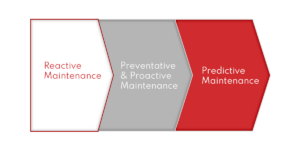
The simplest way to understand preventive vs predictive vs proactive maintenance is to know what needs maintenance and when. Preventive maintenance tells you what needs to be serviced on a routine basis. Predictive maintenance tells you what the equipment data says needs attention. Proactive maintenance tells you why issues occur and how to solve them. Each approach solves a different part of the uptime and production issues.
For food and beverage manufacturers the best strategy is not choosing one over the other. Preventive maintenance gives the production plant a reliable routine maintenance foundation while predictive maintenance helps in prioritizing what needs maintenance. Proactive maintenance helps reduce repeated failures and improving line efficiency. Together, these maintenance strategies create a dependable maintenance program.
What This Looks Like On Food and Beverage Line
It is evident that Predictive maintenance might be the most effective way of handling operations, but it’s relatively new technology that may still be under research and development, and the complexity of the systems that it uses might be off-putting. However, rather than understanding these strategies as competing, it might be more accurate to see them as transitional phases in the global project of achieving zero defect manufacturing. Therefore, the focus should be on understanding the applications and limits of these methods, considering the budgetary restraints and capacity of the facility.
How SmartSkin Supports Smarter Maintenance
SmartSkins solutions is a tool that helps plants implement proactive and preventive approaches to operational efficiency with easy troubleshooting capabilities, empowering teams to optimize production and using data collection to understand your container’s experience on the line. Our Digital Container Twin and software combination accurately identifies pain points on the conveyor lines allowing you to reduce unplanned downtimes and more effectively organize maintenance schedules.
Contact us to learn more about how SmartSkin can help you achieve zero defect manufacturing.

Unlocking operational excellence in food and beverage production.
Explore the numerous benefits of deploying SmartSkin in the food and beverage production industry, and learn how these innovative tools can empower operations and plant managers.