Why We Can’t Rely on the Calendar for Seamer Overhauls
In beverage canning, most of the attention goes to the seam. Far less goes to the downforce on the can inside the seamer, even though that force decides whether the seam holds.
Our Top Load Digital Container Twin measures that vertical load as the can moves through the seamer. It shows what the machine is actually doing, which setup checks and maintenance schedules can’t tell you.
Why Top Load Matters During Changeover
During a changeover, teams need to confirm that the seamer is set up correctly. One of the key things to validate is pin height. If the pin height is off, the downforce applied to the can may be too low or too high.
If the force is too low, the seamer may not hold the can properly through the operation. This can lead to loose seams. Once force gets down around 60 pounds or below, the risk of loose seams becomes a real concern. Loose seams can turn into leakers later in the warehouse, even if the issue is not obvious right away on the line.
If the force is too high, the can may be damaged. Above roughly 110 pounds, the risk starts to move in the other direction. Instead of loose seams, teams may start to see wrinkles, creases, or crushed cans, especially if the incoming cans already have some kind of weakness or damage.
The broader working range may be around 60 to 110 pounds, but the ideal range is tighter than that. In many cases, we want to see the seamer applying force more consistently in the 90 to 105 pound range. That is the area where the process has more room to breathe. It is not too light, and it is not too aggressive.
That is the “just right” zone.
The Problem With Calendar-Based Overhauls
Most plants already have a maintenance plan for their seamers. Parts are replaced after a set period of time. Springs, pins, and other mechanical parts may be changed after three months, six months, or whatever interval the plant has decided is right.
That approach is simple. It is easy to schedule. It is easy to manage.
But it also assumes that every part wears the same way.
That is rarely true.
Mechanical parts do not all behave exactly the same. Even when parts are made to the same specification, there can still be small differences in how they perform over time. One spring may hold up well for the full maintenance period. Another may start to weaken earlier. One head may stay stable. Another may begin to drift.
The issue is that most plants do not see that drift as it starts. They only see the result later.
That result may show up as leakers. Or wrinkled cans. Or a seam issue that causes the team to stop and investigate. By that point, the plant is already reacting to a problem.
The better approach is to catch the mechanical drift before it becomes a quality issue.
What the Top Load Container Twin Shows
The SmartSkin Top Load Container Twin gives teams a way to see how the seamer is applying force through the process.
For example, consider two seamers.
The first seamer is due for an overhaul. When a SmartSkin Top Load Container Twin passes through it, the data shows that the downforce is not very stable. The force starts low, dips during the first operation, picks back up during the second operation, and then dips again as the can exits.
That does not mean every can coming off that line is bad. But it does show that the machine is not applying force as consistently as it should.
The second seamer has just come out of an overhaul. In that case, the top-load data looks much different. The force line is tighter and more stable through both the first and second operation. There are no major dips. The seamer is applying pressure in a much more controlled and predictable way.
That is exactly what a good overhaul should produce.
But the most important question is not just, “Which line looks better today?”
The better question is, “When did the first line start to drift?”
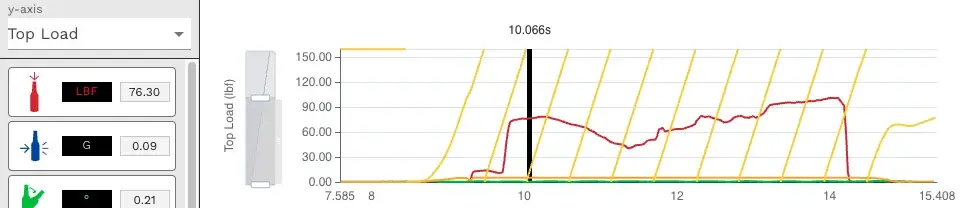
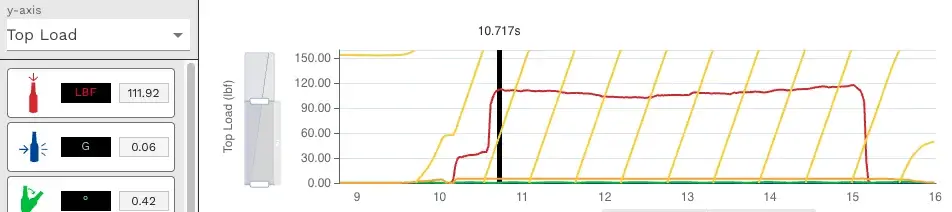
Top-load force profile before and after seamer overhaul.
The first example shows inconsistent downforce, with visible dips as the can moves through the seamer. The second example shows a tighter, more stable force profile after overhaul.
Seeing Wear Before It Becomes a Problem
If a line is checked right before an overhaul, it may not be surprising to see that the seamer is less consistent. Most people would expect some wear by that point.
But what if the drift started weeks earlier?
What if one spring started to weaken before the rest?
What if the line was technically still inside its planned maintenance window, but one part was already performing outside the expected range?
Without data, the plant may not know.
The team may only find out when there is a visible problem. At that point, they may check pin heights. They may inspect incoming cans. They may look at seam measurements. They may review operator setup. Eventually, they may get to the springs or other mechanical parts.
But that process takes time.
SmartSkin gives teams a faster way to understand whether the seamer is applying force properly. By checking top-load force on a regular basis, plants can see trends. They can compare current performance against previous runs. They can identify whether the machine is staying stable or starting to move away from its normal behavior.
That changes the conversation.
Instead of saying, “We replace these parts every six months,” the plant can start asking, “Is this seamer still performing the way it should?”
From Preventive Maintenance to Proactive Maintenance
Preventive maintenance is usually based on time. A plant decides that a part should be replaced after a certain number of weeks, months, cycles, or operating hours.
That is better than waiting for failure.
But proactive maintenance goes a step further.
Proactive maintenance uses real data from the machine to understand what condition the equipment is actually in. It helps teams make better decisions about when to inspect, adjust, or replace parts.
That is where top-load data has real value.
If the seamer is applying force consistently, the plant has confidence that the setup is stable. If the data starts to show dips, spikes, or a wider spread in force, the team can investigate before the issue shows up in production quality.
This does not mean plants need to overhaul seamers every time the data changes. It means they have better information.
They can see whether a problem is developing. They can decide whether an adjustment is needed. They can confirm whether an overhaul actually improved the machine. And they can build a better understanding of how each seamer behaves over time.
Better Data, Better Decisions
Every plant wants to avoid leakers, damaged cans, and unplanned downtime. But avoiding those problems requires more than checking finished seams after the fact.
It requires understanding the conditions that create those seams in the first place.
The SmartSkin Top Load Container Twin helps teams see one of the most important parts of that process: the downforce being applied to the can inside the seamer.
Used during changeovers, it helps confirm that the machine is set correctly. Used before and after overhauls, it helps confirm whether maintenance work made the seamer more stable.
Used on a regular basis, it helps teams spot early signs of wear before they turn into bigger issues.
Seamer maintenance should not only be based on the calendar. It should also be based on how the machine is actually performing.
With SmartSkin, plants can move from assuming the seamer is ready, to knowing it is ready.
Let’s talk about your seamers.
See how top-load data can help your team catch drift before it turns into leakers or crushed cans.