
Understanding Syringe Defects in Fill-Finish: Causes and Prevention Using a Mechanical Baseline
How mechanical shock, pressure, and transport instability create intermittent syringe defects in fill-finish lines
Syringe defects in pharmaceutical fill-finish lines rarely occur in a predictable way. A line can operate at nominal speed for hours before a syringe suddenly cracks, breaks, or becomes damaged during transport. When this happens, teams investigate machine settings, glass quality, and recent adjustments, yet many investigations end without a clear root cause.
The reason is that defects often occur only when several mechanical conditions align at the same moment. Small variations in shock, pressure, or alignment may remain harmless individually, but together they can create the conditions for container damage.
Mechanical shock and handling stresses are known to affect pharmaceutical containers and even the drug product itself. Studies have shown that mechanical shocks applied to filled glass containers can generate cavitation events in the liquid formulation, potentially leading to particle formation and protein aggregation [1].
Because these forces are rarely measured directly during manufacturing operations, the instability often remains invisible. Establishing a mechanical baseline allows manufacturers to detect these deviations early and prevent syringe defects before they occur.
Why Prefilled Syringes Are Highly Sensitive to Mechanical Stress
Prefilled syringes are among the most mechanically sensitive containers used in pharmaceutical manufacturing. Their design introduces several features that make them more vulnerable to mechanical stress than other primary packaging formats such as vials.
Unlike vials, syringes are typically transported using flange-based handling systems, which require precise alignment throughout the line. The container geometry also includes fragile areas such as the needle shield and the thin glass region near the plunger interface.
Even small deviations in alignment or force can introduce stress that the container cannot tolerate.
Glass pharmaceutical containers are particularly sensitive to surface damage. Even minor scratches or mechanical impacts can significantly reduce the strength of glass containers and increase the probability of crack initiation during handling [2]. Because of these characteristics, syringe lines require extremely stable mechanical conditions.
Mechanical Forces That Cause Syringe Defects in Fill-Finish Lines
Two types of mechanical forces commonly contribute to syringe damage during fill-finish operations: shock and pressure.
Shock occurs when containers experience sudden impacts. This can happen when syringes collide with each other, contact metal surfaces, or encounter abrupt movements during machine restarts.
Pressure occurs when containers are pushed together within transport systems. Accumulation areas, mass conveyors, or mismatched machine speeds can create compression forces that increase the mechanical load on the container.
Mechanical shock events in pharmaceutical containers have been shown to generate cavitation bubbles that collapse rapidly, producing localized shock waves that can affect both container integrity and product stability [1].
When shock and pressure occur together, the combined stress can exceed the tolerance of the container and lead to cracks or breakage.
Where Syringe Defects Typically Occur in Pharma Production Lines
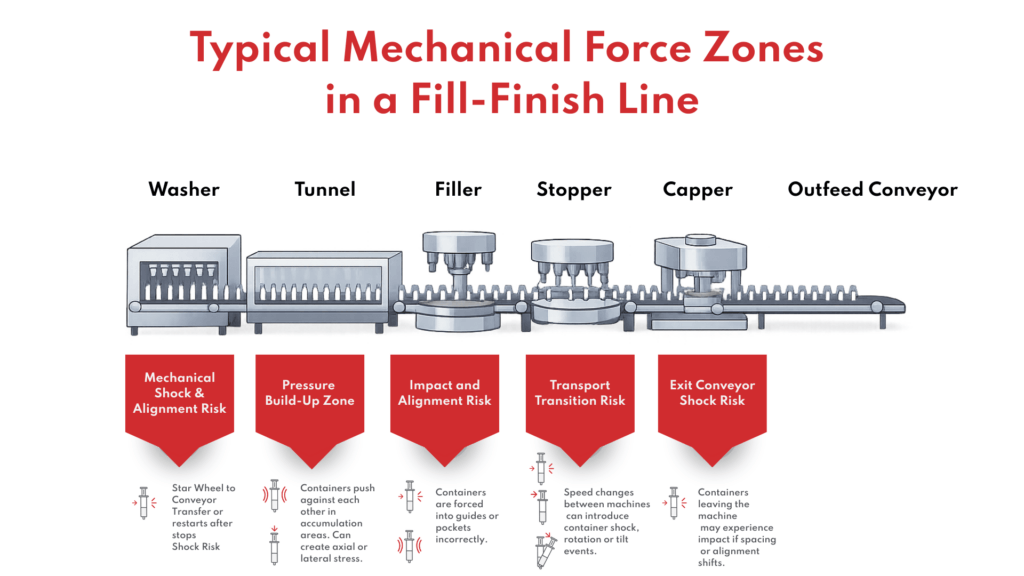
Many syringe defects originate at transport transition points within the line.
These transitions occur whenever containers move between different handling systems, such as:
- star wheel to conveyor
- conveyor to star wheel
- machine-to-machine transfers
- buffer tables and accumulation zones
At these interfaces, containers experience changes in speed, direction, or spacing.
Studies modeling the movement of glass containers on conveyor systems confirm that repeated contact events and speed transitions can create localized stress concentrations that increase the likelihood of breakage [3].These transition zones are therefore among the most critical areas to monitor when investigating syringe defects.
Visualizing Mechanical Risk Zones in a Fill-Finish Line
The diagram below illustrates typical locations where mechanical forces can increase during container transport.
Why Syringe Defects Often Appear Intermittently
One of the most challenging aspects of syringe defects is their intermittent nature.
In many cases, a defect occurs only when several conditions align simultaneously. For example:
- a slightly misaligned transport pocket
- a temporary increase in container pressure
- a minor shock event during transfer
- a particular container position in the transport sequence
Individually, each factor may remain within acceptable limits. When they occur together, however, they can create the conditions required for container damage. Research into cavitation caused by mechanical shock shows that the energy released during bubble collapse is concentrated in extremely small regions, which helps explain why damage may occur sporadically rather than uniformly [1].
Why Root Cause Investigations of Syringe Defects Often Fail
When syringe defects occur, investigations typically focus on visible factors such as container quality, equipment adjustments, or operator actions.
However, one critical type of information is often missing: objective measurements of mechanical forces within the line.
Without data on shock and pressure levels, teams must rely on visual inspection, operator experience, and trial-and-error adjustments.
Regulatory guidance such as USP <1207> Container Closure Integrity Testing emphasizes the importance of ensuring packaging systems maintain integrity throughout the product lifecycle [4]. However, the mechanical conditions that contribute to packaging damage during manufacturing are often not directly monitored.
Establishing a Mechanical Baseline in Fill-Finish Operations
A more reliable approach is to establish a mechanical baseline for the line.
A mechanical baseline represents the force conditions present when the line is operating correctly.
By measuring shock, pressure, and other mechanical variables during stable operation, manufacturers can define the normal behavior of the system.
This reference point allows teams to:
- identify areas where forces are naturally higher within the line
- establish acceptable operating ranges
- detect deviations quickly
Establishing measurable process conditions aligns with broader pharmaceutical manufacturing strategies such as Quality by Design, where critical process parameters are monitored to ensure consistent product quality [5].
Example: Detecting Hidden Instability in a Syringe Line
In one fill-finish operation, a pharmaceutical manufacturer experienced intermittent syringe damage during production. The line was operating within specification and visual inspections did not reveal obvious mechanical issues. However, operators reported occasional defects appearing without a clear pattern.
Initial investigations focused on equipment adjustments and container quality. Because the defects occurred sporadically, the team was unable to reproduce the problem reliably.
To better understand the behavior of the line, engineers performed a mechanical assessment during normal production conditions. By measuring shock and pressure across multiple runs, they established a baseline profile of the forces experienced by containers throughout the transport system.
The analysis revealed localized force spikes at a transition between a star wheel and a conveyor system. Although the alignment appeared correct during visual inspection, small variations in container spacing occasionally produced shock events above the normal operating range.
After adjusting the transition settings and verifying the results against the baseline measurements, the force spikes disappeared. Following the adjustment, the occurrence of syringe defects dropped significantly. This type of assessment demonstrates how mechanical baseline data can reveal instability that is otherwise difficult to detect through conventional investigations.

Troubleshooting Glass Syringe Rejects: 30X Reduction in Needle Shield Rejects
A syringe filling and assembly facility was experiencing high reject rates on a particular syringe line due to the needle shield defects. The root cause was unknown so a comprehensive line assessment was completed with SmartSkin’s syringe container twins.
How a Mechanical Baseline Helps Prevent Syringe Defects
With a defined mechanical baseline, manufacturers gain visibility into conditions that previously remained hidden.
If shock or pressure levels begin to increase at specific points in the line, teams can detect the change early and investigate the cause before container damage occurs.
Baseline measurements can also reveal gradual drift caused by wear, component replacement, or adjustment changes.
Instead of reacting to defects after they occur, manufacturers can move toward proactive process monitoring, identifying risks before they affect product quality.
Conclusion
Syringe defects in pharmaceutical fill-finish operations are rarely random events. They are typically the result of mechanical conditions that fluctuate across the transport system.
Shock, pressure, and alignment variations can combine to create localized instability that remains difficult to detect through traditional inspection methods.
Establishing a mechanical baseline provides the reference needed to understand how forces behave across the line. By defining normal operating conditions and monitoring deviations over time, manufacturers can detect instability earlier and prevent syringe defects before they occur.
In highly sensitive container systems such as prefilled syringes, this visibility is essential for maintaining consistent product quality and stable fill-finish operations.
References
[1] Singh, S. K., Kolhe, P., Wang, W., et al.
Do Not Drop: Mechanical Shock in Vials Causes Cavitation, Protein Aggregation, and Particle Formation.
Journal of Pharmaceutical Sciences.
[2] Bronnbauer, C.
Glass Breakage in Pharmaceutical Packaging.
SCHOTT / PDA Letter.
[3] Lopes, L., et al.
Modeling of Glass Container Damage during Transport on Conveyor Systems.
[4] United States Pharmacopeia
USP <1207> Container Closure Integrity Testing.